Curiosity about cognitive enhancers has grown steadily over the last decade. Alongside prescription wakefulness agents like Modafinil, newer or lesser-known compounds have surfaced in online discussions — among them Fluorenol. But legality is rarely straightforward.In this editorial review, we examine the legal status of fluorenol in the USA, the United Kingdom, and Australia. We’ll also explore how it differs from regulated eugeroics, what clinicians observe in practice, and where it fits within broader pharmaceutical law.
What Is Fluorenol?
Fluorenol (9-hydroxyfluorene) is a synthetic compound structurally related to fluorene, an aromatic hydrocarbon. It is not an FDA-approved medication, nor is it recognized as a licensed therapeutic agent in major regulatory frameworks.
Online, it is often described as a wakefulness-promoting compound. However, unlike established agents listed in the comprehensive Eugeroic drug list, fluorenol has very limited human clinical data.
Mechanism of Action: What Do We Actually Know?
Scientific literature suggests that fluorenol may have dopaminergic or monoaminergic effects in preclinical models. That said:
- No large-scale human trials exist.
- No established dosing guidelines are published.
- No standardized pharmacokinetic data are available.
In contrast, drugs such as Armodafinil and modafinil have well-characterized half-lives, liver metabolism pathways (primarily CYP3A4), and documented safety profiles in peer-reviewed trials.
From a clinician’s perspective, this difference matters. In real-world practice, physicians rely on regulatory approval and published safety data — not anecdotal reports.
Legality of Fluorenol in the USA
Regulatory Classification
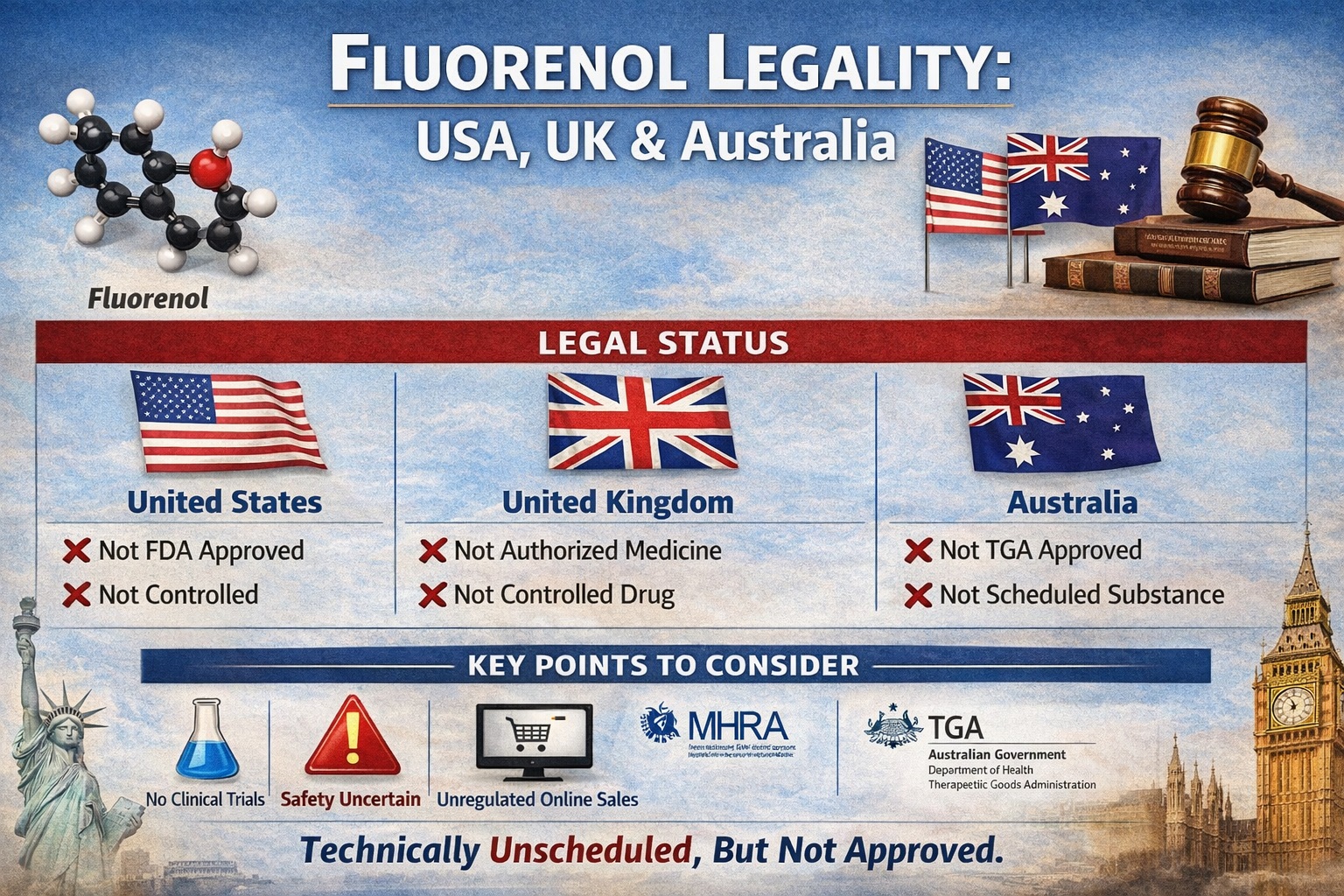
Fluorenol is not scheduled under the Controlled Substances Act. It is also not approved by the U.S. Food and Drug Administration (FDA) as a drug or dietary supplement ingredient.
According to the FDA’s regulatory framework (FDA.gov), substances intended for therapeutic use must undergo approval for safety and efficacy. Fluorenol has not.
Practical Legal Status in the U.S.
| Category | Status |
|---|---|
| FDA-approved drug | No |
| Controlled substance | Not scheduled |
| Dietary supplement ingredient | Not recognized |
| Legal to possess | Generally yes |
| Legal to market for human consumption | Likely no |
In practical terms, this creates a gray zone.
Possession is generally not criminalized. However, marketing fluorenol as a cognitive enhancer for human consumption would likely violate FDA regulations governing unapproved drugs.
Clinically, U.S. physicians do not prescribe fluorenol. Instead, when patients ask about wakefulness agents, discussions center on approved medications such as modafinil or Pitolisant, both supported by regulatory review.
Is Fluorenol Legal in the United Kingdom?
UK Medicines Regulation
In the UK, the Medicines and Healthcare products Regulatory Agency (MHRA) oversees medicines regulation (MHRA.gov.uk).
A substance is classified as a medicinal product if it is presented as treating or preventing disease, or if it exerts a pharmacological effect.
Fluorenol is:
- Not an approved medicinal product
- Not listed as a controlled drug under the Misuse of Drugs Act
Legal Interpretation
Possession of fluorenol is generally not illegal.
However, selling it for ingestion — particularly with therapeutic claims — would likely violate UK medicines legislation.
The UK has historically taken action against “research chemical” vendors making unlicensed medical claims. This distinction mirrors the American regulatory stance: unscheduled does not mean approved.
Is Fluorenol Legal in Australia?
Australia maintains a stricter therapeutic goods framework under the Therapeutic Goods Administration (TGA).
According to the TGA (TGA.gov.au), substances with pharmacological effects intended for human use must be included in the Australian Register of Therapeutic Goods (ARTG).
Fluorenol is:
- Not included in the ARTG
- Not listed as a scheduled substance in the Poisons Standard
What That Means
Possession is unlikely to result in criminal charges.
However, importing fluorenol for human use could trigger regulatory scrutiny under Australia’s therapeutic goods legislation.
Australian clinicians typically recommend approved options such as Solriamfetol when treating excessive daytime sleepiness — never unapproved research chemicals.
Why the Confusion? The Research Chemical Gap
Fluorenol sits in a regulatory gap sometimes occupied by “research compounds.”
It is neither:
- An approved pharmaceutical
- A scheduled narcotic
- A recognized supplement
This intermediate status creates online ambiguity. But from a regulatory science standpoint, absence of scheduling does not equal endorsement.
The NIH database (NIH.gov) emphasizes that compounds lacking formal trials cannot be assumed safe or effective.
Clinical Insights: What Physicians Actually See
In clinical settings, physicians often observe patients experimenting with online cognitive enhancers.
The motivations are understandable:
- Productivity pressure
- Academic performance
- Shift work fatigue
- Curiosity about the difference between nootropics and eugeroics
However, doctors emphasize risk stratification.
Approved agents undergo:
- Controlled dosing studies
- Cardiovascular risk assessment
- Hepatic metabolism evaluation
- Long-term safety monitoring
Fluorenol lacks this framework.
When patients want to safely improve wakefulness, clinicians usually explore approved medications or even behavioral sleep interventions first.
Risks and Unknowns
Because fluorenol is not clinically studied, its safety profile is uncertain.
Potential concerns may include:
- Unknown neurotoxicity
- Unpredictable cardiovascular effects
- Drug interactions
- Impurities in unregulated supply chains
By comparison, the known Side effects of modafinil include headache, nausea, anxiety, and rare but serious dermatologic reactions — all documented in FDA labeling.
With fluorenol, we simply do not have comparable transparency.
That uncertainty is itself a risk.
Comparing Fluorenol to Approved Eugeroics
If someone is researching “what are eugeroics” or exploring the modafinil legal status, context helps.
Here is a simplified comparison:
| Feature | Fluorenol | Modafinil | Pitolisant |
|---|---|---|---|
| Regulatory approval | None | FDA-approved | FDA-approved |
| Clinical trials | Minimal | Extensive | Extensive |
| Prescription required | N/A | Yes | Yes |
| Known mechanism | Theoretical | Dopamine modulation | Histamine H3 inverse agonist |
| Legal clarity | Gray area | Clearly regulated | Clearly regulated |
Consumers exploring options often encounter online vendors. For example, discussions about Modafinil vendors frequently arise when prescription access is limited.
However, legally and medically, regulated pathways remain safer.
For individuals seeking structured information on purchasing regulations, educational resources such as Buy Modafinil outline the legal and medical considerations around approved medications.
Regulatory Notes by Country (Summary)
United States
- Not scheduled
- Not FDA-approved
- Illegal to market for therapeutic use
United Kingdom
- Not controlled
- Illegal to sell as medicine without authorization
Australia
- Not scheduled
- Not approved under ARTG
- Importation for human use may violate therapeutic goods law
In all three countries, fluorenol exists outside formal pharmaceutical approval systems.
The Broader Ethical Question
There is a deeper issue beyond legality.
Modern wakefulness agents like modafinil, pitolisant, and solriamfetol underwent years of controlled study before approval. Regulatory agencies require demonstrated safety, defined pharmacology, and standardized manufacturing.
Fluorenol has not met those standards.
In medicine, caution is not conservatism — it is patient protection.
Conclusion
So, is fluorenol legal in the USA, UK, and Australia?
Technically, it is not scheduled or outright banned in these jurisdictions. But it is also not approved, not clinically validated, and not legally marketable as a therapeutic drug.
This places it in a regulatory gray zone.
For general readers exploring cognitive enhancers, the key takeaway is simple: legality and safety are not the same. Approved eugeroics have regulatory oversight for a reason. Fluorenol does not.