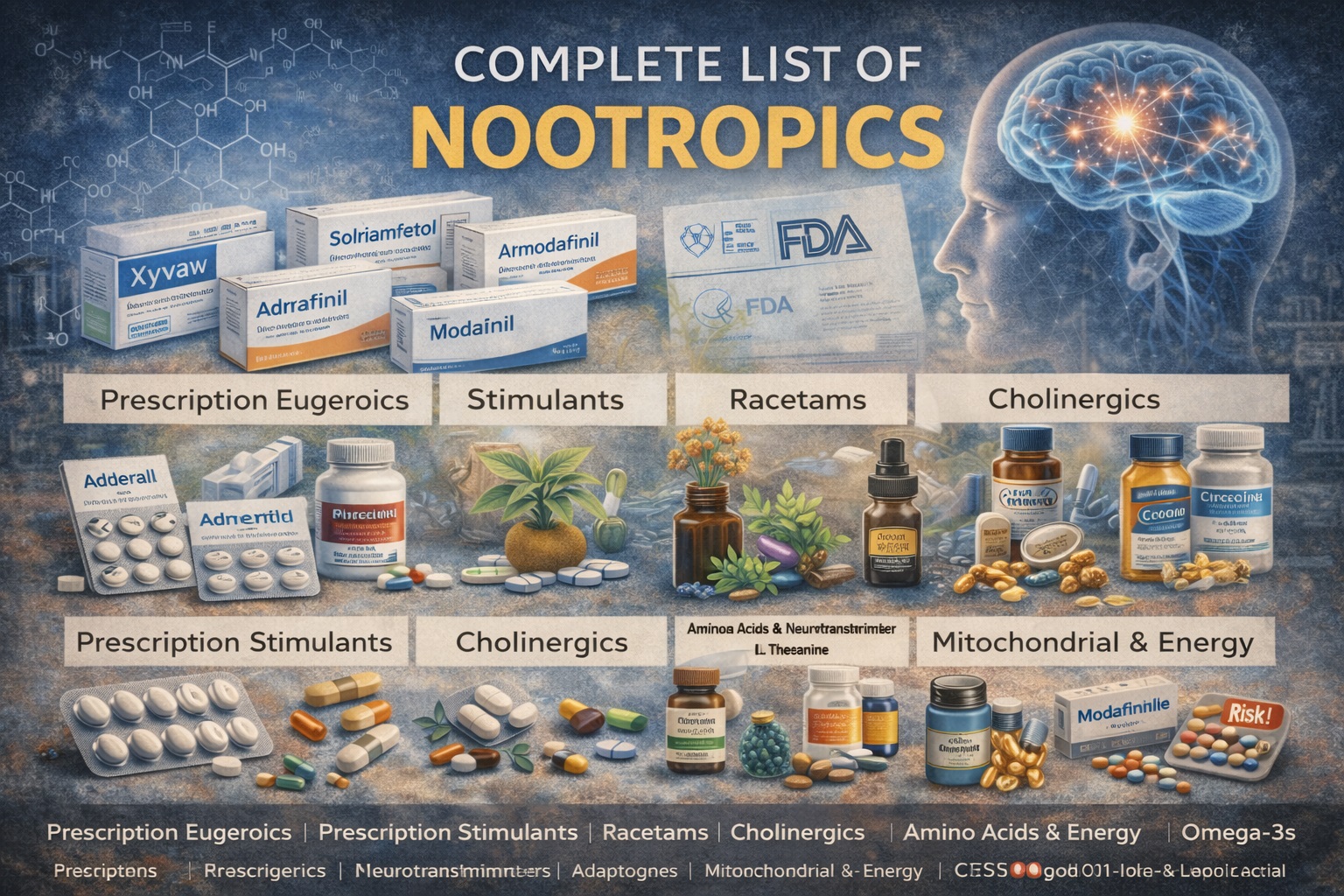
Nootropics are often described as “brain boosters,” but that label hides a big truth: the category includes prescription drugs, dietary supplements, and experimental compounds—some well-studied, others mostly theoretical. Many lists online mix these together without telling you which items have strong clinical evidence and which are still “maybe.” The result is confusion, especially for non-experts. This guide is designed to be readable and useful: a categorized list of nootropics, what they’re typically used for, and what to know about evidence, safety, and regulation. For a narrower focus on wakefulness-promoting medications specifically, see the Eugeroic drug list.
What counts as a “nootropic” in real life?
In strict historical terms, the word “nootropic” was meant to describe compounds that enhance learning and memory while being very safe. In modern usage, it’s become broader: “anything that might help cognition, focus, mood, or wakefulness.” That expansion is exactly why lists become messy.
A practical way to understand nootropics is to group them by mechanism + regulatory status, and to be honest about evidence quality.
Category 1: Prescription eugeroics (wakefulness-promoting agents)
These are the most “medical-journalism-safe” nootropics to list, because they’re regulated, prescribed, and studied for sleep-wake disorders.
| Compound | Typical clinical use | Core mechanism (simplified) |
|---|---|---|
| Modafinil | Narcolepsy, shift-work sleep disorder, OSA-related sleepiness | Wakefulness pathways; dopamine transporter effects among others |
| Armodafinil | Similar to modafinil | Related pharmacology; longer-lasting in many users |
| Solriamfetol | Excessive daytime sleepiness (narcolepsy/OSA) | Dopamine/norepinephrine reuptake inhibition |
| Pitolisant | Narcolepsy (in some regions) | Histamine H3 receptor inverse agonism/antagonism |
| Xywav | Narcolepsy (cataplexy/EDS, jurisdiction-dependent) | Sleep architecture modulation (clinical use is tightly controlled) |
In clinical settings, physicians often observe that eugeroics can improve daytime function and sustained attention, but they’re not “IQ pills.” They also have meaningful interaction and side-effect profiles, so the safest framing is: indication-first, not performance-first.
Regulatory note: the official U.S. prescribing information for modafinil (Provigil) is a useful reference for indications and key risks.
If you’re building internal topical clusters on Eugeroics.com, supporting pages often discussed alongside modafinil include Modalert and Modvigil. For availability-oriented readers, you can reference buy modafinil in an informational (non-promotional) context.
Category 2: Prescription stimulants (often misused as “study drugs”)
These are not eugeroics, but they frequently appear in nootropic discussions because they can improve attention in certain diagnosed conditions.
- Adderall (amphetamine salts)
- Methylphenidate-class medicines (commonly discussed alongside Adderall in public discourse)
This category is where misuse risk rises sharply. Many countries treat these as controlled substances, and diversion (using without a prescription) carries both health and legal risks.
For a broader conceptual frame, see Stimulants.
Category 3: Racetams and “classic smart drugs” (mixed evidence, complex regulation)
Racetams are among the most frequently listed “nootropics,” but evidence is uneven, and regulatory status varies widely by country. Some compounds in this group are prescription medicines in certain regions, while others are sold online with inconsistent quality control.
Commonly discussed racetams:
- Piracetam
- Aniracetam
- Oxiracetam
- Pramiracetam
- Phenylpiracetam
- Coluracetam
A key caution: U.S.-based regulatory and medical literature has raised repeated concerns about racetams being sold in supplement-like channels despite not being approved as dietary supplements or drugs in the U.S.
Category 4: Cholinergics and acetylcholine support (attention, memory networks)
This category is popular because acetylcholine is central to attention and memory encoding.
Common examples:
- Citicoline (CDP-choline)
- Alpha-GPC
- Phosphatidylcholine
- Acetyl-L-carnitine (often grouped here due to cognitive/energy discussions)
These tend to be discussed as “support” compounds rather than standalone cognitive enhancers.
Category 5: Amino acids and neurotransmitter-adjacent nutrients
These are widely used because they’re accessible and have plausible mechanisms, but effects can be subtle and context-dependent.
Common examples:
- L-theanine (often paired with caffeine)
- Tyrosine (stress/workload contexts)
- Taurine
- 5-HTP (serotonin precursor—important interaction cautions)
This is also where readers can over-assume safety. “Natural” does not automatically mean “risk-free,” especially with psychiatric meds.
Category 6: Adaptogens and stress-modulating botanicals
Many “brain booster” products focus less on raw cognition and more on stress resilience, since chronic stress reliably harms attention and memory.
Common examples:
- Ashwagandha
- Rhodiola rosea
- Panax ginseng
- Bacopa monnieri
The best-supported claims here are usually about stress, fatigue, and subjective well-being, with cognition improving indirectly for some people.
Category 7: Mitochondrial/energy and “brain metabolism” supports
These appear in list of nootropics because mental fatigue can be driven by sleep, nutrition, and metabolic factors.
Common examples:
- Creatine (especially under sleep deprivation or heavy cognitive load)
- CoQ10
- Alpha-lipoic acid
- Magnesium (various forms)
- B-vitamins (especially when deficient)
These are often best viewed as “brain health basics,” not instant-performance enhancers.
Category 8: Omega-3s and structural brain-health nutrients
Omega-3 fatty acids are frequently listed because DHA is a major structural component in neural tissue and is tied to broader health evidence. The NIH Office of Dietary Supplements provides practical, evidence-based guidance on omega-3 intake and limitations of conversion from plant sources.
Common examples:
- DHA/EPA (fish oil)
- ALA (plant omega-3; conversion is limited)
Category 9: “Modafinil-like” and investigational eugeroic-adjacent compounds
This is the gray zone: compounds discussed online as “like modafinil,” often with limited human safety data.
Examples commonly discussed in nootropic circles:
- Adrafinil (a prodrug to modafinil; liver considerations are often raised)
- Flmodafinil
- Fluorenol
- Category explainers like Like eugeroics and OTC eugeroics
This category is where quality control and misinformation risk is highest. If you include it, it’s worth explicitly labeling it as investigational / limited evidence.
Clinical insights: what “works” depends on the problem
In real clinical life, the most common reason someone feels “less sharp” isn’t a lack of nootropics—it’s sleep debt, untreated anxiety/depression, medication side effects, or iron/B12/thyroid issues. That’s why the most responsible nootropics content pairs lists with guidance like: talk to a Doctor if fatigue or attention problems are persistent or worsening.
For performance seekers, nootropics are often used to Get work done, but clinicians typically emphasize a hierarchy:
- sleep and schedule stability
- mental health and stress
- nutrition and exercise
- then, carefully chosen interventions
Risks and side effects: the part lists often bury
A responsible list should say this plainly: nootropics can cause harm, especially when stacked, overdosed, or mixed with psychiatric meds.
Common issues across categories:
- Insomnia, anxiety, appetite changes
- Elevated heart rate/blood pressure (more typical with stimulants)
- Drug interactions (SSRIs, MAOIs, anticoagulants, etc.)
- Variable purity in unregulated products
For a structured overview, readers can consult Side effects.
Regulatory notes: “available online” is not the same as “approved”
One of the most useful guardrails for readers is learning the difference between:
- FDA-approved medications (with prescribing info, manufacturing standards, pharmacovigilance)
- Dietary supplements (regulated differently; quality varies)
- Unapproved drugs sold in supplement-like channels (a known problem category)
Large pharmacovigilance systems exist because adverse effects happen even with approved medicines; WHO’s Programme for International Drug Monitoring is a good example of how safety monitoring works globally.
Conclusion
A “complete list of nootropics” isn’t one list—it’s a map of categories with different evidence levels and different safety realities. If you want the most clinically grounded starting point, begin with regulated eugeroics and work outward cautiously. And if a list doesn’t clearly separate prescription medicines, supplements, and experimental compounds, treat it as marketing, not education.
If you want, I can also produce a download-ready table version (CSV-style formatting) of the list above for your editors.