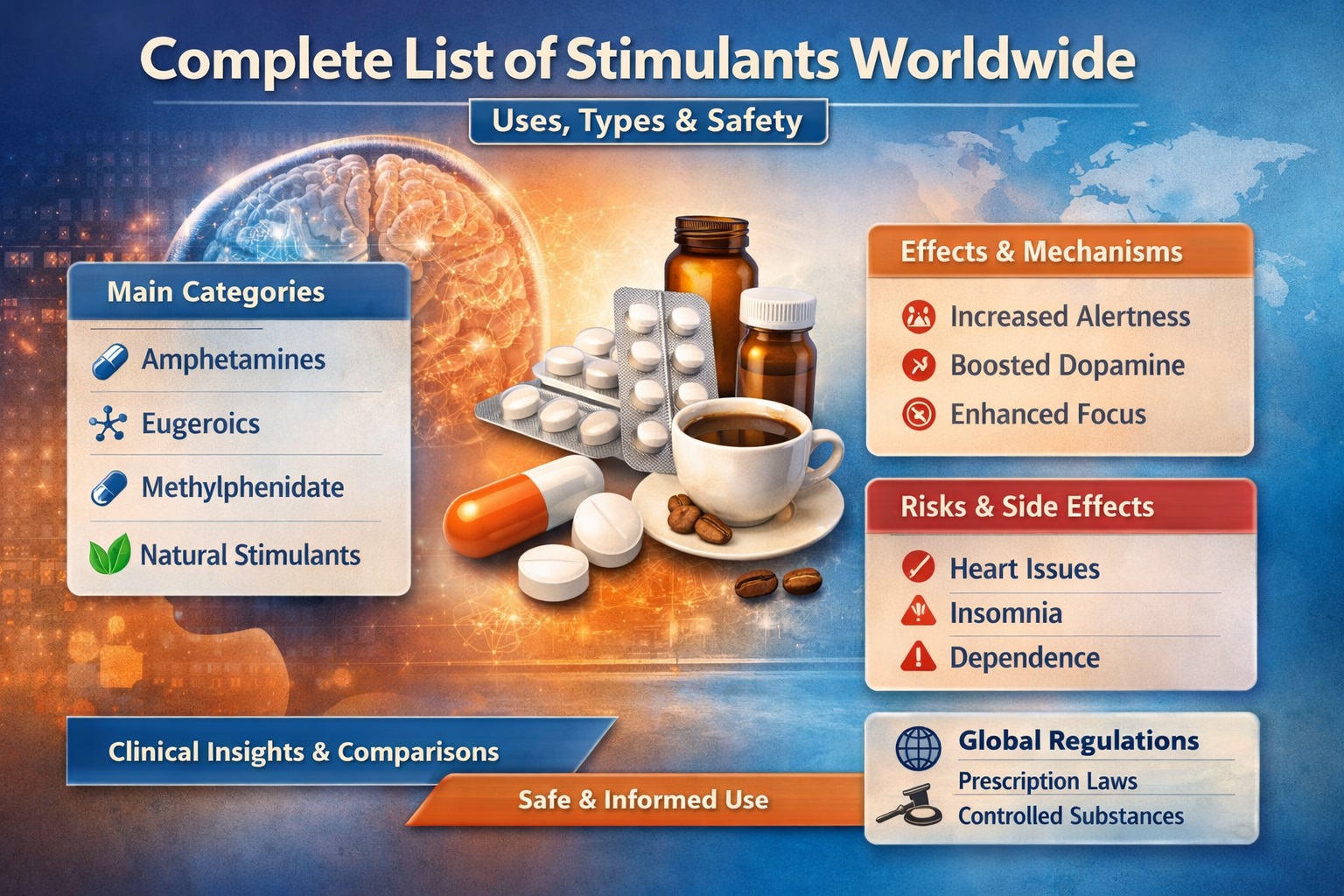
Introduction — Why Stimulants Matter More Than Ever
Stimulants sit at the crossroads of medicine, productivity culture, and neuroscience. They are prescribed to treat serious sleep and attention disorders, used off-label for fatigue and cognition, and consumed daily in milder forms by billions of people. Despite their ubiquity, most public discussions flatten stimulants into a single category. In reality, this is a pharmacologically diverse family with sharply different mechanisms, risks, and clinical roles. This article offers a wide, globally informed list of stimulants—from classic amphetamines to newer wake-promoting agents—written for curious, non-expert readers who want accuracy without unnecessary complexity. For readers interested specifically in wakefulness agents, a curated Eugeroic drug list provides a focused companion reference.
What Are Stimulants? Definitions & Neurobiology
Core Definition
Stimulants are substances that increase central nervous system activity, leading to heightened alertness, attention, and wakefulness. Most achieve this by modulating dopamine, norepinephrine, histamine, or orexin signaling.
Classic stimulants directly amplify neurotransmitter release. Newer agents often work indirectly, shaping wakefulness circuits rather than forcing stimulation.
Stimulants vs. Wakefulness Agents
Traditional Stimulants activate the sympathetic nervous system, raising heart rate and blood pressure. Eugeroics, by contrast, are designed to promote alertness without the same degree of physiological “push.”
Clinically, this distinction matters. It influences prescribing decisions, long-term tolerability, and abuse potential.
A Truly Complete List of stimulants
A. Amphetamines & Amphetamine Derivatives
These are among the most powerful prescription stimulants.
Examples
- Adderall (mixed amphetamine salts)
- Dextroamphetamine
- Lisdexamfetamine (Vyvanse)
- Methamphetamine (restricted medical use in select countries)
Mechanism
They promote dopamine and norepinephrine release while inhibiting reuptake.
Clinical insight: Physicians often observe excellent symptom control in ADHD, but also the highest rates of insomnia, appetite loss, and anxiety.
B. Methylphenidate-Based Stimulants
Examples
- Methylphenidate (Ritalin, Concerta)
- Dexmethylphenidate
These drugs primarily block dopamine and norepinephrine reuptake, producing a more linear stimulation profile.
They are widely used in Europe, North America, and parts of Asia, particularly in pediatric ADHD.
C. Wakefulness-Promoting Eugeroics
This category has expanded rapidly over the past two decades.
Approved agents
Distinct mechanisms
- Modafinil: indirect dopamine transporter inhibition
- Solriamfetol: dopamine–norepinephrine reuptake inhibition
- Pitolisant: histamine H₃ receptor antagonism
Comparative discussions—such as Modafinil and Pitolisant—highlight that “alertness” can be pharmacologically achieved in very different ways.
D. Prodrugs & Metabolic Precursors
Adrafinil converts to modafinil in the liver, resulting in delayed onset and additional hepatic considerations. Clinicians tend to view it as less predictable.
E. Research & Grey-Market Analogs
These compounds show stronger dopamine affinity and longer half-lives. However, absence of regulatory approval means safety data remains limited.
F. Non-Prescription & Dietary Stimulants
- Caffeine (coffee, tea, energy drinks)
- Nicotine
- Yohimbine
- Select OTC eugeroics
- Plant-derived compounds grouped as Natural eugeroics
Even “mild” stimulants exert measurable cardiovascular and neurochemical effects, especially when stacked or combined with prescriptions.
Off-Label Use: Why Stimulants Extend Beyond Diagnosis
Stimulants are often used outside formal indications to combat fatigue, jet lag, shift-work sleep disorder, or cognitive burnout. Articles framed around productivity—such as Get work done—reflect this demand.
In clinical settings, physicians often encounter professionals using wakefulness agents episodically rather than chronically. Evidence quality varies, and ethical considerations remain active topics of debate.
Clinical Perspectives From Practice
Clinicians frequently emphasize that response to stimulants is highly individualized. Two patients on the same drug may experience opposite outcomes.
Sleep disorders specialists increasingly prioritize nighttime sleep consolidation, sometimes using agents like Xywav, before escalating daytime stimulation.
A recurring observation: patients seeking “clean focus” often tolerate eugeroics better than classic stimulants.
Risks, Tolerance & Side effects
Common risks across stimulant classes include:
- Cardiovascular strain
- Anxiety and irritability
- Sleep disruption
- Appetite suppression
Amphetamines carry the highest abuse potential. Eugeroics are not risk-free, but generally show lower reinforcement in clinical trials.
Long-term use should be periodically reassessed rather than assumed indefinite.
List of stimulants: Comparative Overview
| Category | Abuse Risk | CV Impact | Wakefulness Quality |
|---|---|---|---|
| Amphetamines | High | High | Forceful |
| Methylphenidate | Moderate | Moderate | Focused |
| Eugeroics | Low–Moderate | Lower | Sustained |
Discussions around the Best eugeroic typically conclude that suitability depends on diagnosis, lifestyle, and risk tolerance—not raw potency.
Regulation & Legal Status (Global View)
Regulation varies sharply by country:
- U.S.: Amphetamines (Schedule II), modafinil (Schedule IV)
- EU: Stricter off-label controls
- Asia-Pacific: Highly variable enforcement
Authoritative guidance is available through:
Legal access, prescription norms, and monitoring requirements differ widely.
Practical Considerations & Ethics
Any stimulant decision should involve a qualified Doctor. This is particularly important for individuals with hypertension, arrhythmias, or anxiety disorders.
Use in competitive settings, including Sports, may breach anti-doping rules even when medically prescribed.
Readers exploring supply chains often encounter discussions about Modafinil vendors or how to buy modafinil, underscoring the importance of legality, quality control, and medical supervision.
Conclusion
List of stimulants is not a single tool, but an entire pharmacological spectrum. From caffeine to amphetamines to modern eugeroics, each class reflects a different philosophy of how wakefulness should be achieved.
Understanding these distinctions empowers safer, more informed conversations—whether in a clinic, a workplace, or personal health decisions.