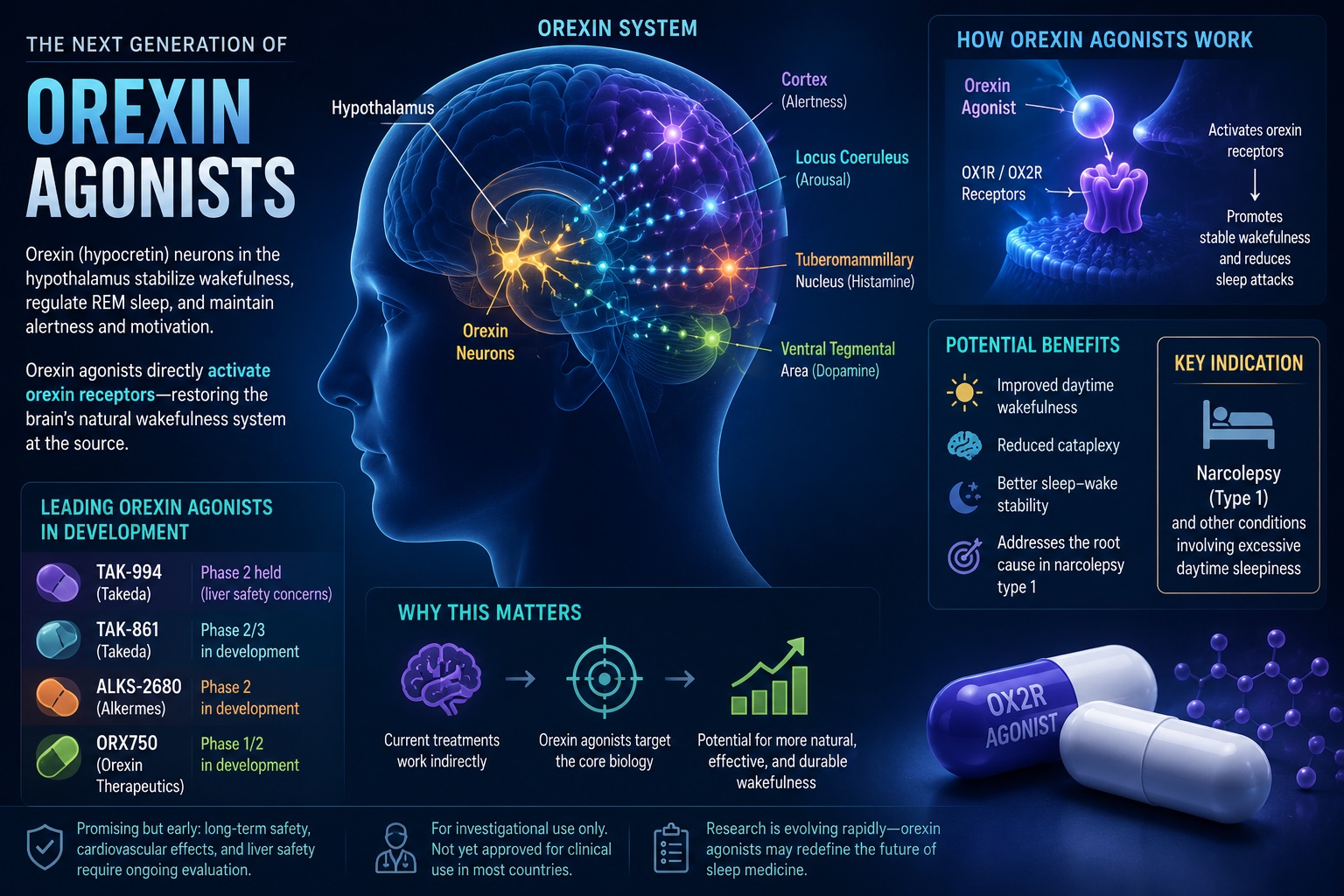
For decades, wakefulness medicine has largely focused on indirect stimulation. Drugs like Modafinil and Solriamfetol improve alertness through dopamine, norepinephrine, and histamine systems—but they do not directly repair the biological circuitry disrupted in narcolepsy. Orexin agonists may change that entirely.
Rather than amplifying downstream neurotransmitters, these experimental compounds aim to replace or mimic the very neurochemical signal missing in narcolepsy itself: orexin, also called hypocretin.
Among the most closely watched compounds is TAK-994, a direct orexin receptor agonist that generated enormous excitement in sleep medicine before safety concerns interrupted development.
Even so, researchers increasingly believe orexin agonists may represent the next major leap in eugeroic pharmacology.
What Is Orexin?
Orexin is a neuropeptide produced in the hypothalamus that stabilizes wakefulness and prevents sudden transitions into sleep.
It plays a critical role in:
- maintaining alertness
- regulating REM sleep
- sustaining motivation and arousal
- stabilizing sleep-wake boundaries
In narcolepsy type 1, orexin-producing neurons are largely destroyed.
A landmark review from Nature Reviews Neurology on orexin and narcolepsy describes orexin deficiency as the central biological driver of narcolepsy with cataplexy.
This discovery transformed how researchers think about sleep disorders.
Why Current Eugeroics Are Limited
Existing eugeroics improve wakefulness indirectly.
For example:
- Modafinil primarily affects dopamine transporter activity
- Pitolisant enhances histamine signaling
- Solriamfetol inhibits dopamine and norepinephrine reuptake
These medications can significantly improve daytime functioning, but they do not restore the missing orexin system itself.
As a result, many patients still experience:
- breakthrough sleepiness
- unstable wakefulness
- fragmented sleep
- cataplexy symptoms
This limitation inspired the search for a more biologically targeted solution.
What Are Orexin Agonists?
Orexin agonists are medications designed to activate orexin receptors directly.
Instead of stimulating secondary neurotransmitter systems, they attempt to mimic the effects of natural orexin peptides.
This is important because orexin functions like a “stability signal” for wakefulness.
Researchers hope these drugs may eventually:
- restore more natural alertness
- reduce cataplexy
- improve sleep architecture
- stabilize circadian wakefulness patterns
In theory, this could produce a more physiologic form of wakefulness than traditional stimulants or indirect eugeroics.
TAK-994: The First Major Breakthrough
TAK-994, developed by Takeda Pharmaceuticals, became one of the first highly promising oral orexin receptor 2 agonists.
Early clinical data generated remarkable interest in the sleep medicine community.
A report presented through
Takeda clinical development updates on TAK-994 showed substantial improvements in wakefulness among narcolepsy patients.
Researchers observed:
- dramatic reductions in daytime sleepiness
- improved maintenance of wakefulness
- reductions in cataplexy episodes
Some sleep specialists described the effects as potentially transformative.
Why TAK-994 Was Paused
Despite strong efficacy, development encountered a major obstacle.
Takeda halted clinical development after liver safety concerns emerged during trials.
This illustrates a recurring reality in neuropharmacology:
Powerful mechanisms often come with unexpected biological complexity.
Importantly, however, the concept itself was not abandoned.
Many researchers believe the liver toxicity may have been compound-specific rather than mechanism-specific.
That distinction matters enormously for the future of orexin agonists.
The New Wave of Orexin Agonists
After TAK-994, several companies accelerated development of newer orexin receptor agonists.
These include:
- TAK-861
- ALKS-2680
- ORX750
- other selective OX2R agonists
A clinical pipeline review from Sleep Review Magazine on emerging orexin agonists highlights how pharmaceutical development rapidly shifted toward safer second-generation molecules.
Researchers are now focusing on:
- improved receptor selectivity
- reduced hepatotoxicity risk
- more stable pharmacokinetics
Why Orexin Agonists Could Change Narcolepsy Treatment
Current narcolepsy treatment often involves combining multiple medications:
- stimulants
- sodium oxybate products
- antidepressants
- wakefulness-promoting agents
This approach can become complex and inconsistent.
Direct orexin agonists may eventually simplify treatment by targeting the core biological deficit itself.
A review from
The Lancet Neurology discussing orexin-targeted therapies describes orexin replacement strategies as one of the most promising future directions in sleep medicine.
Potential Advantages Over Traditional Eugeroics
Compared with classic Stimulants or indirect eugeroics, orexin agonists may offer several theoretical benefits.
| Potential Feature | Traditional Eugeroics | Orexin Agonists |
|---|---|---|
| Dopamine dependence | Moderate | Minimal |
| Cataplexy control | Limited | Potentially strong |
| Physiologic wakefulness | Partial | More natural |
| Abuse potential | Variable | Possibly lower |
This distinction could significantly alter how clinicians approach long-term narcolepsy management.
Beyond Narcolepsy: Other Possible Applications
Researchers are also exploring whether orexin agonists could help conditions involving:
- hypersomnia
- traumatic brain injury fatigue
- Parkinson’s disease sleepiness
- depression-related hypersomnia
Interest is especially high in psychiatry because fatigue and cognitive slowing remain difficult to treat.
Some experts speculate future orexin agonists could eventually become a major branch of advanced eugeroic therapy.
Clinical Perspective: A Paradigm Shift
In practical terms, orexin agonists represent a shift from:
“forcing wakefulness”
to
“restoring wakefulness regulation.”
This is a fundamentally different philosophy.
Rather than pushing the brain into stimulation, these drugs may eventually help recreate the biologic stability that healthy orexin systems naturally provide.
Sleep neurologists increasingly view this as one of the most exciting developments in modern sleep medicine.
Risks and Unknowns
Despite enormous promise, important uncertainties remain.
Researchers still need long-term data regarding:
- cardiovascular safety
- liver effects
- tolerance development
- psychiatric impacts
The history of TAK-994 demonstrates why cautious clinical development remains essential.
Like all wakefulness therapies, future orexin agonists will require careful evaluation of potential Side effects.
The Future of Eugeroics
The broader field of wakefulness medicine is evolving rapidly.
Traditional agents such as:
helped establish the foundation of modern eugeroic pharmacology.
Orexin agonists may represent the next evolutionary step—one that moves closer to correcting the biology of sleep-wake disorders themselves.
For patients with narcolepsy, this could eventually mean:
- more stable daytime alertness
- fewer medications
- improved quality of life
- better physiologic sleep regulation
Conclusion
Orexin agonists like TAK-994 represent one of the most ambitious developments in modern sleep medicine.
Although early setbacks revealed important safety challenges, the underlying concept remains extraordinarily promising: restoring wakefulness through direct orexin receptor activation rather than indirect stimulation.
For narcolepsy research, this may signal the beginning of a new therapeutic era.
And for the broader science of eugeroics, orexin agonists could redefine what “wakefulness promotion” means entirely.
Medical Disclaimer
This article is for informational purposes only and not a substitute for professional medical advice. Always consult a qualified healthcare provider.