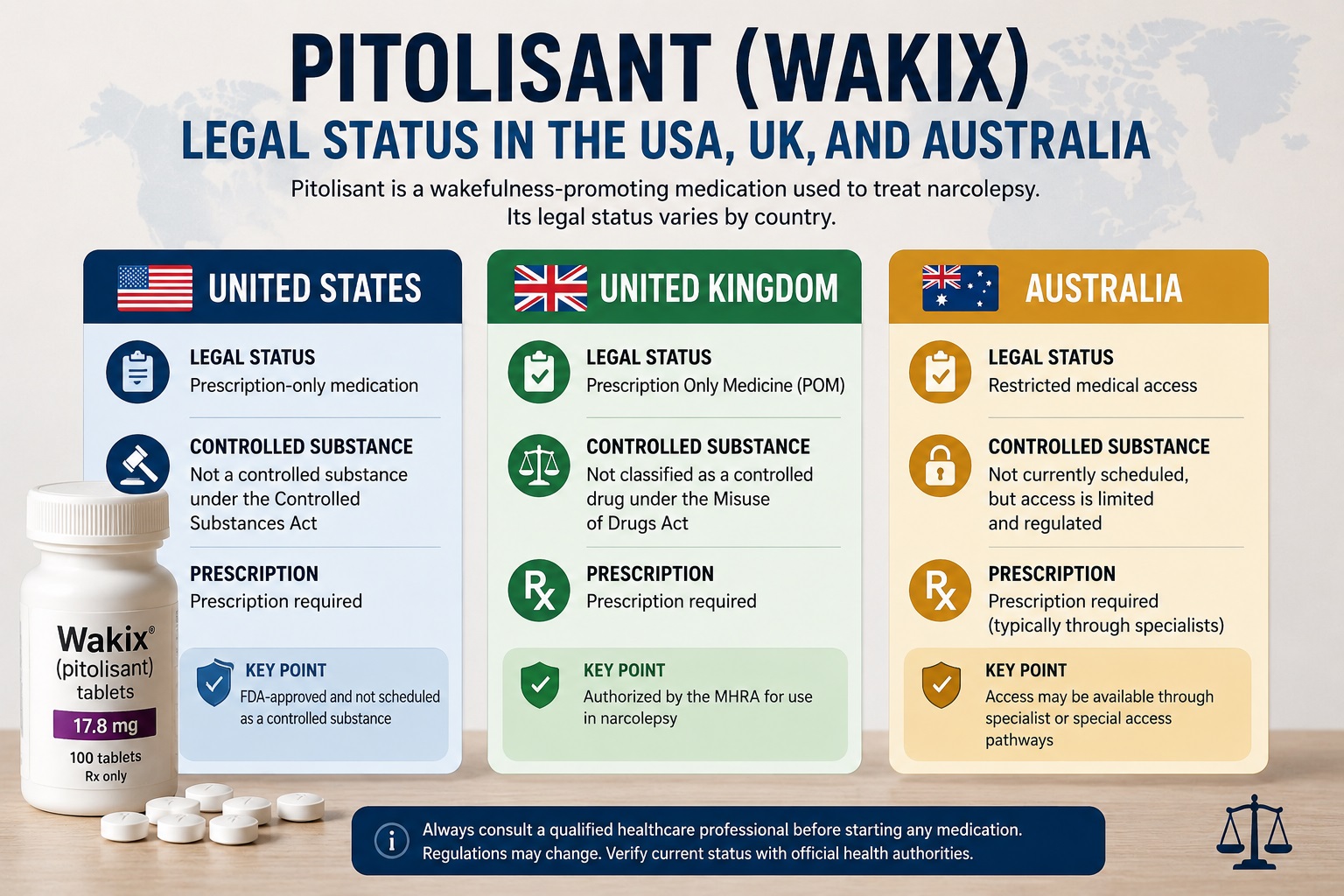
Pitolisant is one of the most pharmacologically unique wakefulness-promoting medications currently available. Unlike traditional stimulants, it works through the brain’s histamine system rather than directly stimulating dopamine release. Marketed primarily under the brand name Wakix, pitolisant has become increasingly important in the treatment of narcolepsy and excessive daytime sleepiness. However, its legal and regulatory status differs across countries. This article explains legality of pitolisant in the United States, United Kingdom, and Australia, including prescription rules, scheduling classifications, and medical access.
What Is Pitolisant?
Pitolisant is a histamine H3 receptor inverse agonist used primarily to treat:
- narcolepsy
- excessive daytime sleepiness (EDS)
- cataplexy associated with narcolepsy
Unlike classic Stimulants, pitolisant enhances wakefulness by increasing histamine signaling in the brain.
A pharmacological overview from the
European Medicines Agency review of pitolisant describes it as the first clinically available medication targeting the histamine H3 receptor for narcolepsy treatment. Pitolisant’s active ingredient is pitolisant hydrochloride, a histamine H3 receptor inverse agonist that promotes wakefulness by increasing histamine signaling in the brain rather than directly stimulating dopamine release.
Pitolisant belongs to the broader family of wakefulness-promoting compounds listed in the Eugeroic drug list.
Legality of Pitolisant in the USA
In the United States, pitolisant:
- is FDA-approved
- is available only by prescription
- is notably NOT classified as a controlled substance
This makes pitolisant unusual among wakefulness-promoting medications.
FDA Approval
The FDA approved Wakix (pitolisant) in 2019 for excessive daytime sleepiness in adults with narcolepsy. Additional approvals later expanded its indications.
The official
FDA orphan drug approval listing for Wakix documents its approval history and indications.
Why It Is Not Controlled
Unlike medications such as Modafinil or amphetamine-based stimulants, pitolisant demonstrated:
- low abuse potential
- minimal euphoric effects
- limited reinforcing behavior in clinical studies
A review published in CNS Drugs examining pitolisant in narcolepsy notes that pitolisant is considered to have a very low risk of dependence compared with traditional stimulants.
Practical Implications
In practice:
- prescriptions are still required
- medical supervision remains necessary
- possession without prescription may still violate federal or state laws
However, the absence of controlled-substance scheduling generally simplifies prescribing and refill processes.
Legality of Pitolisant in the United Kingdom
In the UK, pitolisant is regulated as a:
- Prescription Only Medicine (POM)
- medication approved under MHRA oversight
The UK Medicines and Healthcare products Regulatory Agency lists pitolisant-containing Wakix products within its medicines database.
The official
MHRA product listing for pitolisant medicines confirms active authorization of Wakix formulations in the United Kingdom.
UK Regulatory Characteristics
- available only with prescription
- typically prescribed by sleep specialists
- regulated through NHS and private healthcare systems
Unlike some ADHD medications, pitolisant is generally not treated as a high-risk controlled stimulant under UK misuse legislation.
Legality of Pitolisant in Australia
Australia has historically taken a more cautious approach to newer wakefulness-promoting drugs.
At present, pitolisant access in Australia is:
- more limited than in the USA or UK
- typically managed through specialist pathways or evolving approval frameworks
According to the
Therapeutic Goods Administration medicine scheduling framework, wakefulness-promoting medications are assessed based on safety, abuse risk, and clinical necessity.
Some reports suggest access may occur through:
- specialist prescribing
- Special Access Scheme pathways
- future broader approval mechanisms
Because Australian regulations evolve over time, patients should verify current status directly through healthcare providers and TGA resources.
Comparison Between Countries
| Country | Legal Classification | Prescription Required | Controlled Substance |
|---|---|---|---|
| USA | Prescription-only | Yes | No |
| UK | Prescription Only Medicine | Yes | Typically no |
| Australia | Restricted medical access | Usually yes | Regulated medicine |
Key Insight
Pitolisant differs from many wakefulness agents because regulators generally view it as having:
- lower abuse potential
- reduced addictive risk
- non-amphetamine pharmacology
This significantly affects how it is scheduled internationally.
Why Pitolisant Is Treated Differently
Most wakefulness medications affect dopamine strongly.
Pitolisant primarily targets the histamine system, which changes its abuse-risk profile.
Its mechanism increases histamine release indirectly through H3 receptor antagonism rather than causing large dopamine surges.
This distinction explains why pitolisant is often discussed as a unique or “next-generation” eugeroic.
Compared with medications such as Solriamfetol or amphetamine stimulants, regulators generally perceive pitolisant as having a safer dependency profile.
Clinical Perspective
In clinical settings, physicians may consider pitolisant when patients:
- cannot tolerate stimulants
- have concerns about dependency
- require long-term wakefulness support
Because it works differently from dopamine-heavy stimulants, some patients report:
- smoother alertness
- less jitteriness
- reduced rebound fatigue
However, response varies considerably between individuals.
Consultation with a qualified
Doctor remains essential before initiating treatment.
Risks and Side Effects
Despite its lower abuse profile, pitolisant still carries potential risks.
Common Side effects may include:
- insomnia
- nausea
- anxiety
- headache
FDA prescribing documentation also notes the possibility of QT interval prolongation, particularly in vulnerable individuals.
The official
FDA prescribing information for Wakix outlines dosing guidance, contraindications, and safety precautions.
Global Regulatory Trends
Interest in pitolisant continues growing internationally because of its distinct pharmacology and low abuse potential.
Additional countries are evaluating:
- broader approval pathways
- pediatric indications
- expanded sleep-disorder applications
Recent developments involving generic pitolisant formulations suggest that access may increase globally in the coming years.
Conclusion
Pitolisant occupies a unique regulatory position among wakefulness-promoting medications.
- In the United States, it is prescription-only but not federally scheduled as a controlled substance.
- In the United Kingdom, it is regulated as a Prescription Only Medicine under MHRA oversight.
- In Australia, access remains more restricted and medically supervised.
Its lower abuse potential and histamine-based pharmacology distinguish it from many traditional stimulants and contribute to its comparatively flexible legal treatment.
As research expands, pitolisant may become an increasingly important option in sleep medicine and wakefulness pharmacology.