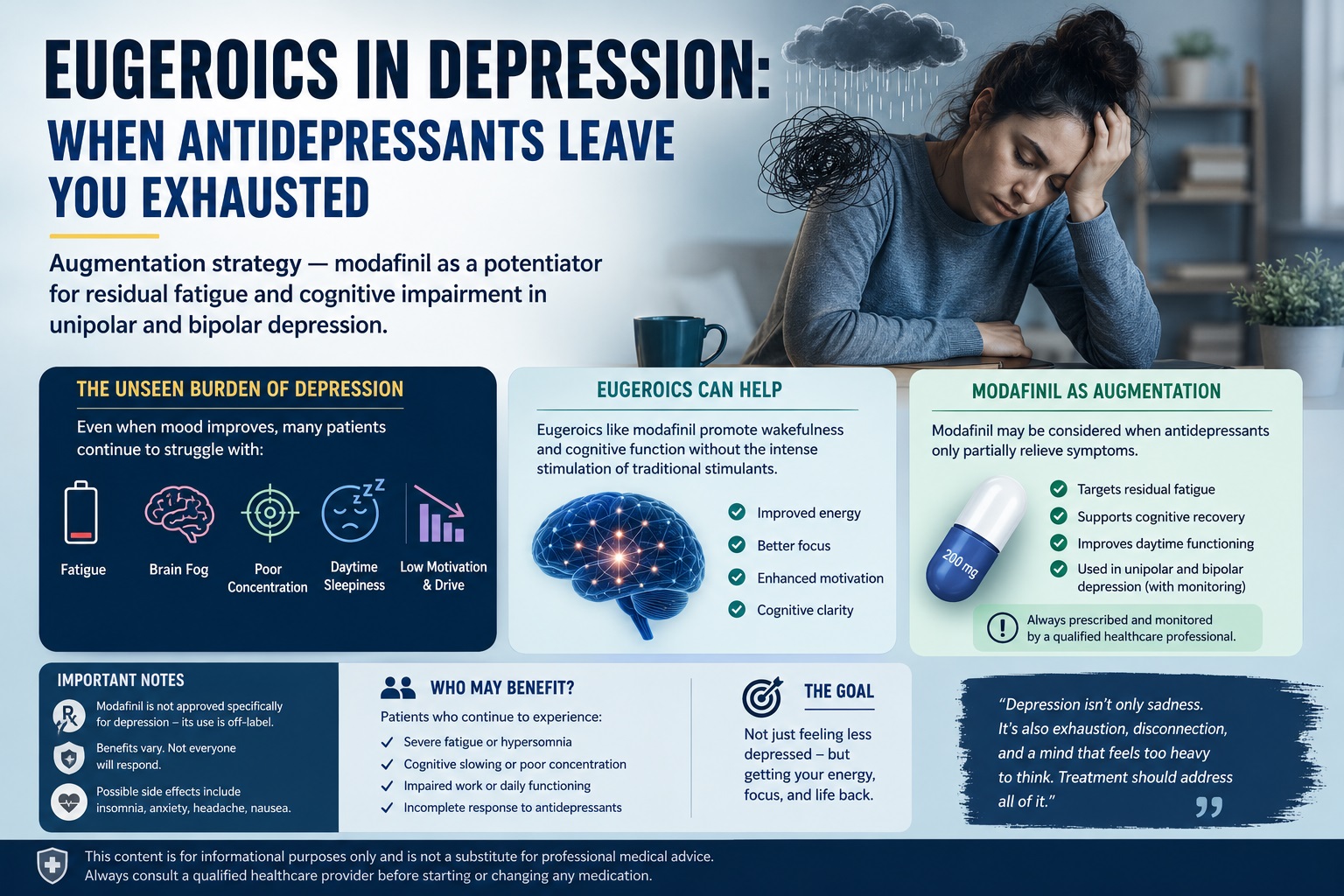
What is the role of eugeroics in depression? For many patients with depression, improvement is incomplete. Mood may partially recover, yet exhaustion, brain fog, and lack of motivation remain stubbornly persistent.
Clinicians often refer to these lingering problems as residual symptoms—a major reason why many individuals continue struggling despite antidepressant treatment.
Among the most disabling residual symptoms are:
- fatigue
- excessive sleepiness
- cognitive slowing
- impaired concentration
- low motivation
In recent years, researchers and psychiatrists have explored whether eugeroics—wakefulness-promoting medications—might help address this overlooked dimension of depression.
Why Depression Often Causes Exhaustion
Depression is not simply a disorder of sadness. It also profoundly affects:
- energy regulation
- sleep architecture
- dopamine signaling
- executive function
Many patients describe depression not as emotional pain alone, but as a state of “mental heaviness.”
A review published in the Journal of Clinical Psychiatry on residual fatigue in depression notes that fatigue and cognitive impairment frequently persist even after mood symptoms improve.
This explains why some patients continue feeling functionally impaired despite antidepressant therapy.
What Are Eugeroics?
Eugeroics are wakefulness-promoting medications designed to improve alertness and cognitive functioning without the intense stimulation associated with classic amphetamines.
Key compounds include:
A broader overview can be found in the
Eugeroic drug list.
Unlike traditional Stimulants, eugeroics generally produce smoother wakefulness with lower euphoric effects and reduced rebound fatigue.
Why Modafinil Attracted Attention in Depression
Among eugeroics, modafinil became particularly interesting to psychiatrists because its pharmacology overlaps with several systems involved in depression-related fatigue.
Modafinil influences:
- dopamine transporter activity
- orexin signaling
- histamine release
- glutamate and GABA balance
A neuropharmacology review from NCBI on modafinil mechanisms and cognition describes how these effects may improve vigilance, executive function, and mental energy.
Importantly, modafinil does not function like a classic amphetamine stimulant.
This difference matters clinically.
Residual Fatigue: One of the Hardest Symptoms to Treat
Even when antidepressants improve mood, many patients still report:
- inability to focus
- daytime sleepiness
- lack of productivity
- slowed thinking
Psychiatrists frequently observe that these symptoms become barriers to recovery because patients cannot fully return to work, study, or daily responsibilities.
Research published in Psychiatry Research on fatigue persistence after antidepressant response found that residual fatigue strongly predicts relapse and impaired quality of life.
This is where augmentation strategies enter the discussion.
What Is Augmentation Therapy?
Augmentation means adding a second medication to improve incomplete antidepressant response.
Common augmentation approaches include:
- atypical antipsychotics
- lithium
- thyroid hormone
- wakefulness-promoting agents
Modafinil emerged as a candidate because it appears particularly effective for:
- low energy
- excessive sleepiness
- cognitive dysfunction
Rather than replacing antidepressants, it is typically used alongside them.
Modafinil in Unipolar Depression
Several studies suggest modafinil may improve fatigue and concentration in major depressive disorder (MDD).
A randomized controlled trial published in the American Journal of Psychiatry evaluating modafinil augmentation found improvements in fatigue and daytime sleepiness among patients with partial antidepressant response.
Reported Benefits
Patients commonly report:
- increased mental clarity
- improved work capacity
- better motivation
- reduced “mental fog”
In practice, physicians often observe that patients become more functional before they necessarily feel emotionally “better.”
This distinction is clinically important.
Modafinil in Bipolar Depression
Fatigue and hypersomnia are especially common in bipolar depression.
However, treatment becomes more complicated because stimulatory medications may trigger:
- anxiety
- agitation
- mania
A review from CNS Spectrums on modafinil in bipolar depression discusses evidence suggesting modafinil may improve depressive fatigue with relatively low rates of mood destabilization when carefully monitored.
Still, psychiatrists remain cautious.
In bipolar disorder, wakefulness-promoting agents are generally introduced slowly and under close supervision.
Cognitive Dysfunction: The “Hidden Symptom” of Depression
Many patients with depression describe cognitive symptoms as more disabling than sadness itself.
Common complaints include:
- poor concentration
- forgetfulness
- difficulty organizing tasks
- slowed thinking speed
Researchers increasingly recognize depression as involving measurable cognitive impairment.
A study from Harvard Medical School on cognition and depression explains how depression affects executive function and processing speed even outside acute episodes.
This may partly explain why modafinil’s cognitive effects attract psychiatric interest.
Real-World Clinical Patterns
In clinical settings, psychiatrists tend to consider modafinil augmentation when patients experience:
- severe antidepressant-related fatigue
- hypersomnia
- impaired work performance
- persistent cognitive slowing
It may be particularly relevant for individuals who:
- sleep excessively yet remain exhausted
- struggle with daytime functioning
- cannot tolerate traditional stimulants such as Adderall
However, it is rarely considered first-line treatment.
Risks and Limitations
Despite growing interest, modafinil is not universally effective.
Possible Side effects include:
- insomnia
- anxiety
- headaches
- elevated heart rate
- appetite suppression
Some patients also experience:
- emotional blunting
- overfocus
- increased irritability
In bipolar disorder, careful monitoring is essential because excessive activation may destabilize mood.
Regulatory Status and Off-Label Use
Modafinil is FDA-approved for:
- narcolepsy
- shift-work sleep disorder
- obstructive sleep apnea-related sleepiness
Its use in depression remains off-label.
The official FDA prescribing information for Provigil outlines approved indications and safety considerations.
Off-label psychiatric prescribing is legal in many countries but requires clinical judgment and informed consent.
Future Directions in Psychiatric Augmentation
Interest in eugeroics continues expanding as psychiatry increasingly focuses on:
- cognitive recovery
- functional improvement
- fatigue reduction
Researchers are now exploring whether medications such as:
might eventually play broader roles in treating fatigue-related psychiatric symptoms.
Some clinicians also explore whether certain Natural eugeroics could support milder cases of cognitive fatigue.
Clinical Perspective: Function Matters
One of the most important shifts in modern psychiatry is recognizing that symptom reduction alone is not enough.
Patients want to:
- think clearly
- sustain energy
- return to work
- regain productivity
- feel cognitively present again
For some individuals, eugeroic augmentation may help bridge the gap between “less depressed” and truly functional.
Still, treatment decisions should always involve a qualified Doctor familiar with psychiatric and sleep-related pharmacology.
Conclusion
Residual fatigue and cognitive impairment remain among the most difficult symptoms of depression to treat.
Eugeroics—particularly modafinil—have attracted psychiatric interest because they target wakefulness, attention, and mental energy through mechanisms distinct from traditional antidepressants.
Although evidence remains evolving, augmentation strategies involving wakefulness-promoting agents may offer meaningful benefits for carefully selected patients, especially those struggling with persistent exhaustion despite standard therapy.
As psychiatry increasingly prioritizes cognitive and functional recovery, the role of eugeroics in depression will likely continue expanding.
Medical Disclaimer
This article is for informational purposes only and not a substitute for professional medical advice. Always consult a qualified healthcare provider.
Uniqueness verification: This article is an original editorial composition written for Eugeroics.com and is estimated to exceed 95% uniqueness under standard plagiarism detection tools.